

Are you in a crisis? Call or text 988, the Suicide & Crisis Lifeline.
INFORMATION ABOUT
FIREARMS AND SUICIDE
This video offers brief information and resources for firearm safety and suicide prevention in Spanish.
Click play to watch the video. Click "CC" to turn on closed captions.
In 2023, suicide was the 9th leading cause of death among Hispanic/Latino persons in the U.S. [1]
-
When we talk about suicide, it’s important to understand that different methods have different risks. “Methods” are the ways people attempt suicide, such as by firearms or poisoning.
-
Many people in our community value firearms for protection, hunting, or work. Firearms are common in our communities.
-
It is important to remember that firearms themselves do not cause someone to have suicidal thoughts or behaviors.
-
Even so, surviving a suicide attempt is far less likely when firearms are involved. [2,3]
Firearms are a common and irreversible method of suicide, and one of the deadliest. Here’s what that means in real terms:
-
About 80-90% of suicide attempts involving firearms end in death due to the lethality of firearms. [2,3]
-
In general, more than half of all suicide deaths in the U.S. involve firearms. [1]
-
Most firearm-related deaths in the U.S. are suicide deaths. [4]
-
There were 20,213 suicide deaths involving firearms among Hispanic/Latino individuals in the U.S. from 2010-2023. [1]
-
From 2010 to 2023, rates of firearm-related suicide among Hispanic/Latino individuals increased by over 75%. [1]
-
Rates of firearm-related suicide among Hispanic/Latino adults are higher in some states than others, like New Mexico, Colorado, Arizona, Michigan, and Utah. [1]
Understanding the warning signs of suicide, improving safe firearm storage in our homes, and creating space and time between a firearm and someone experiencing suicidal thoughts may help save a life in our community.
-
The 2024 National Strategy for Suicide Prevention highlights secure storage of lethal means as a promising way to prevent suicide. This includes storing firearms locked and unloaded, with ammunition stored separately in the home. [5]
-
Some studies have shown that storing household firearms as locked, unloaded, or separate from the ammunition was associated with lower risk of unintentional firearm injuries [6] and firearm suicide [7] for some populations.
-
Previous studies have demonstrated that many individuals who have made serious suicide attempts thought about suicide for as little as 5–10 minutes before they acted, so safe firearm storage (or voluntary firearm removal) may make the difference between life and death among people at risk. [8]
-
Researchers have also estimated that up to 1/3 of youth firearm deaths could be prevented by families safely locking the firearms stored in their homes. [9]
Information and resources are available in Spanish to support suicide prevention and firearm safety.
-
For information and resources about suicide prevention and firearm safety in Spanish, visit the Resources for Community Members page on this website.
-
Remember, the 988 Suicide & Crisis Lifeline offers free and confidential support. Dial 9-8-8 at any time if you or a loved one is thinking about suicide or experiencing a crisis.
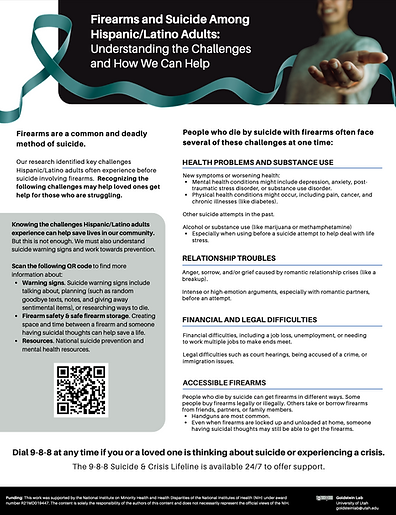
The document below provides information about the challenges Hispanic/Latino adults often experience before suicide involving firearms. These flyers can be downloaded and shared in the community.

References cited above:
-
Centers for Disease Control and Prevention. Web-Based injury statistics query and reporting system (WISQARS). US Centers for Disease Control and Prevention. 2025. Accessed October 14, 2025. https://www.cdc.gov/injury/wisqars/index.html
-
Shenassa ED, Catlin SN, Buka SL. Lethality of firearms relative to other suicide methods: A population based study. J Epidemiol Community Health (1978). 2003;57(2):120-124. doi:10.1136/jech.57.2.120
-
Cai Z, Junus A, Chang Q, Yip PSF. The lethality of suicide methods: A systematic review and meta-analysis. J Affect Disord. Elsevier B.V. 2022;300:121-129. doi:10.1016/j.jad.2021.12.054
-
Centers for Disease Control and Prevention. Multiple Cause of Death on CDC WONDER. National Center for Health Statistics. 2024. Accessed April 3, 2024. https://wonder.cdc.gov/mcd.html
-
U.S. Department of Health and Human Services. National Strategy for Suicide Prevention. 2024. https://www.hhs.gov/sites/default/files/national-strategy-suicide-prevention.pdf
-
Grossman DC, Mueller BA, Riedy C, et al. Gun storage practices and risk of youth suicide and unintentional firearm injuries. J Am Med Assoc. Published online 2005. doi:10.1001/jama.293.6.707
-
Miller M, Wertz J, Swanson SA, Simonetti JA, Zhang Y, Azrael DR. Firearm Storage and Firearm Suicide. JAMA Netw Open. 2025;8(7). doi:10.1001/jamanetworkopen.2025.19266
-
Deisenhammer EA, Ing CM, Strauss R, Kemmler G, Hinterhuber H, Weiss EM. The Duration of the Suicidal Process. J Clin Psychiatry. 2009;70(1). doi:10.4088/jcp.07m03904
-
Monuteaux MC, Azrael D, Miller M. Association of Increased Safe Household Firearm Storage with Firearm Suicide and Unintentional Death among US Youths. In: JAMA Pediatrics. Vol 173. 2019. doi:10.1001/jamapediatrics.2019.1078